
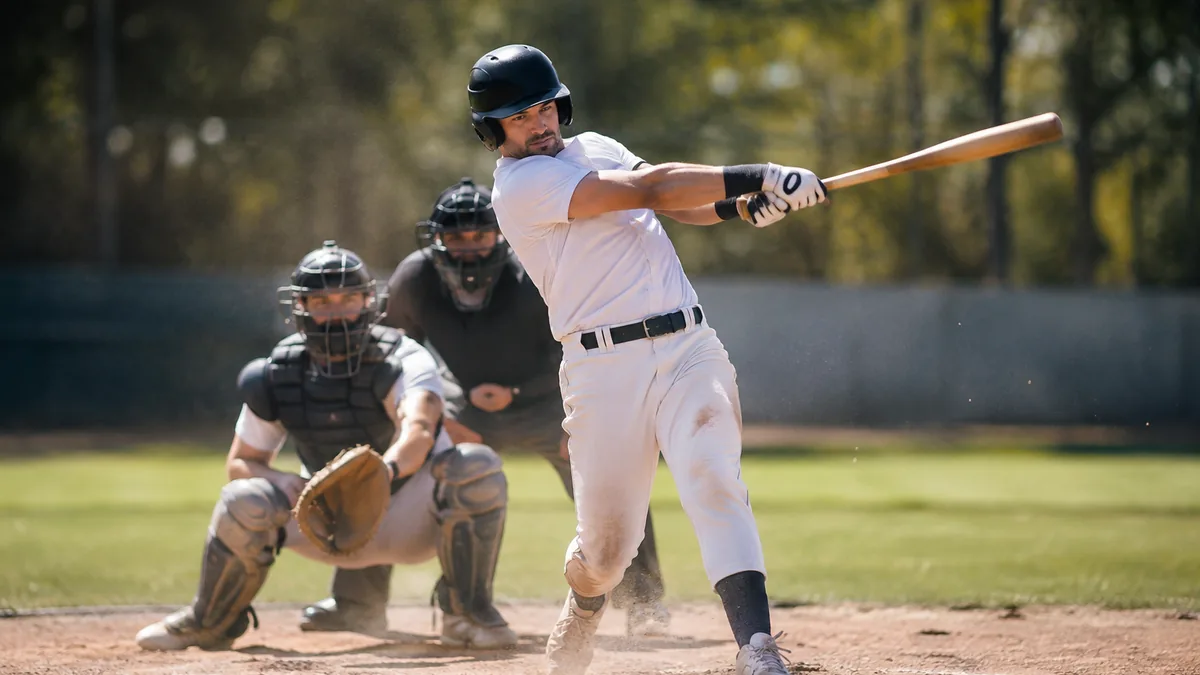
OPS is a hitting stat that combines two things: how often a batter reaches base and how much power the batter shows when he does hit the ball. The name stands for on-base plus slugging, and the formula is exactly what the name says. It is a quick way to see how much a hitter contributes at the plate.
This guide explains slugging percentage and on-base percentage first, then shows how they add up to OPS, with worked examples and a look at what the stat can and cannot tell you.
Batting average and what it misses
Batting average is the stat most casual fans know. It is hits divided by at-bats. It is easy to compute, but it treats all hits the same: a single and a home run count equally. It also ignores walks entirely. A player who walks a lot looks no better than one who rarely does, even though reaching base is the goal.
Slugging percentage fixes the first problem, and on-base percentage fixes the second. OPS joins them.
Slugging percentage (SLG)
Slugging percentage measures the number of bases a hitter earns per at-bat. It gives more credit to extra-base hits.
SLG = total bases ÷ at-bats
Total bases are counted like this:
- Single: 1
- Double: 2
- Triple: 3
- Home run: 4
Walks are not counted. So SLG is, in effect, a batting average that weights power.
Worked example
A hitter has 100 at-bats with 20 singles, 5 doubles, 1 triple and 4 home runs.
- Total bases: 20 × 1 + 5 × 2 + 1 × 3 + 4 × 4 = 20 + 10 + 3 + 16 = 49
- Divide by at-bats: 49 ÷ 100 = 0.490
This hitter has a slugging percentage of .490. The batting average, for comparison, would be 30 hits in 100 at-bats, or .300.
Slugging percentage can be higher than 1.000 over a small sample, because a home run is worth four bases per at-bat. Over a full season, numbers like that are very rare.
On-base percentage (OBP)
On-base percentage measures how often a batter reaches base, counting hits, walks and hit-by-pitches.
OBP = (hits + walks + hit by pitch) ÷ (at-bats + walks + hit by pitch + sacrifice flies)
The denominator includes plate appearances where reaching base was possible. It leaves out sacrifice bunts and catcher's interference.
Worked example
Take the same hitter with 100 at-bats and 30 hits. Add 12 walks, 2 hit-by-pitches and 3 sacrifice flies.
- Numerator: 30 + 12 + 2 = 44
- Denominator: 100 + 12 + 2 + 3 = 117
- OBP: 44 ÷ 117 = 0.376
This hitter has an on-base percentage of .376.
OPS: putting them together
OPS = OBP + SLG
You simply add the two numbers. For the hitter above:
.376 + .490 = .866
The hitter has an OPS of .866.
OPS is usually written with three decimal places, and often without the leading zero, as in .866. Some fans call a number above .900 or 1.000 excellent, but these are rough guides. What counts as strong depends on the league and the era.
How to read OPS
OPS is useful because it is quick and it includes both getting on base and hitting for power. A hitter with a high OBP and low power can have the same OPS as a hitter with a low OBP and high power.
A few ways to use it:
- Compare players at the same level and in the same season. A league average OPS changes from year to year.
- Check both parts. Look at OBP and SLG separately to see what kind of hitter you are looking at.
- Use a large sample. A hot week can produce a huge OPS that does not last.
- Remember context. Park effects, the quality of the opposing pitchers and the batting order all matter.
You may also see OPS+, a version that adjusts for the park and the league, set so that 100 is average. That makes it easier to compare players across different parks and eras. Check the definition on the site you use.
Limits of OPS
OPS is a shortcut, so it has some known problems.
- It adds two numbers with different scales. OBP is a rate per plate appearance, while SLG is a rate per at-bat, and the two are not equally valuable. Many analysts argue that on-base percentage deserves more weight than slugging percentage. OPS gives them equal weight in the formula.
- It ignores baserunning and defense. A fast runner or a great fielder gets no credit in OPS.
- It does not account for situation. A home run with the bases loaded and one with the bases empty count the same in SLG.
- Small samples mislead. Pinch hitters and part-time players can show extreme values.
Because of these limits, OPS works best as a first look, followed by more detailed stats if you need them.
Where you will see OPS
You will find OPS on broadcast graphics, in box scores and on player pages. It is also common in youth and college baseball, because the numbers needed to calculate it (at-bats, hits, walks, total bases) are all in a normal scorebook. If you keep score, our baseball rules for beginners and baseball terms glossary will help with the terms you see in a scorebook.
For pitching stats, which use different formulas, see our guides to ERA and WHIP.
Quick checklist
- Count total bases: 1 for a single, 2 for a double, 3 for a triple and 4 for a home run.
- Divide total bases by at-bats to get slugging percentage.
- Add hits, walks and hit-by-pitches, and divide by at-bats plus walks, hit-by-pitches and sacrifice flies to get on-base percentage.
- Add the two numbers to get OPS.
- Compare with other hitters in the same league and season.
FAQ
What does OPS mean in baseball?
OPS means on-base plus slugging. It is a batter's on-base percentage added to his slugging percentage, and a higher number is better.
How do you calculate OPS?
Calculate on-base percentage and slugging percentage, then add them. For example, an OBP of .376 and a SLG of .490 gives an OPS of .866.
What is slugging percentage?
Slugging percentage is total bases divided by at-bats. It gives more credit to doubles, triples and home runs than to singles.
What is a good OPS?
It depends on the league and the era. Compare a hitter's OPS with the league average for the same season. Many fans treat .800 or higher as solid and .900 or higher as very good, but these are only rough guides.
Is OPS better than batting average?
OPS shows more, because it includes walks and power, while batting average counts every hit equally and ignores walks. Neither tells the whole story, so many people look at both.