
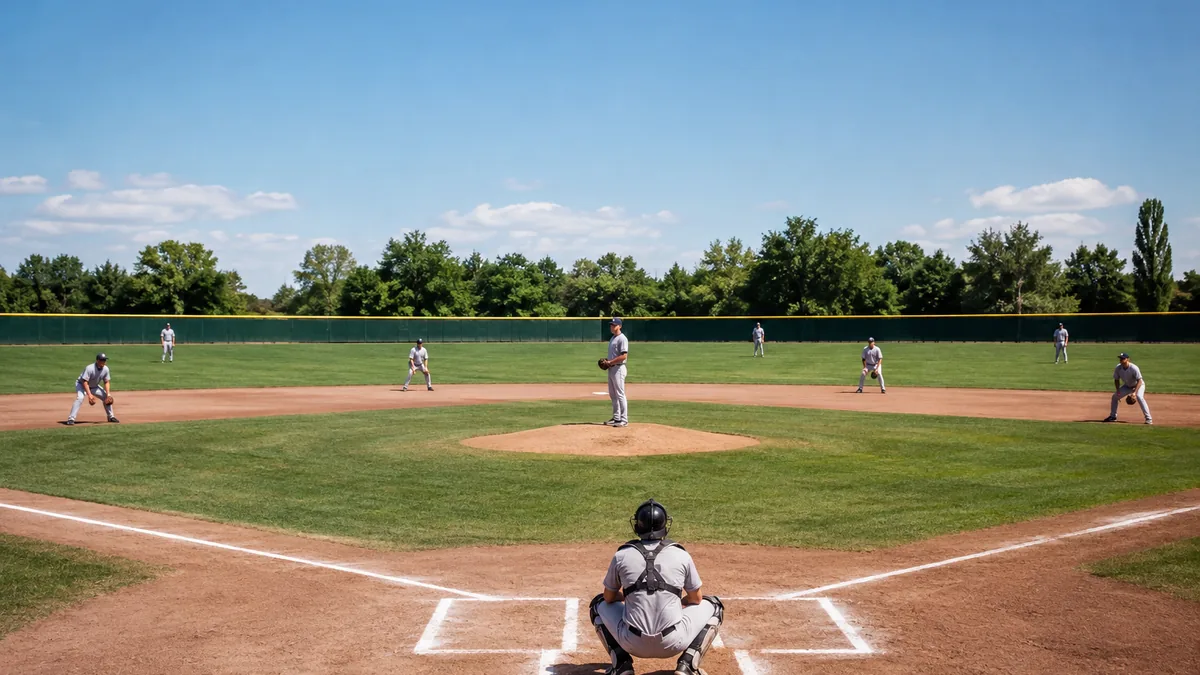
"How many players are on a baseball team?" has several correct answers, because the question can mean three different things: how many players a team has on the field, how many bat in the lineup, and how many are on the full roster. This guide separates the three and explains how the numbers change between professional, school, youth and recreational baseball.
Players on the field: nine
At any moment during a game, the defending team has nine players on the field. They are the pitcher, the catcher, four infielders and three outfielders:
- Pitcher (position 1) and catcher (position 2).
- Infield: first baseman (3), second baseman (4), third baseman (5) and shortstop (6).
- Outfield: left fielder (7), center fielder (8) and right fielder (9).
The numbers are the scorekeeping numbers that scorers use. If you are not familiar with them, read baseball positions by number and baseball positions explained for the diagram and the role of each player.
Some local and youth formats use a fourth outfielder or a different number of defenders to fit a smaller field or a smaller group of players. That is a local format, not the standard game, so confirm it in the league rules.
Players in the batting order: nine, sometimes ten
A team bats in a fixed order. In a standard game, each team has a batting lineup of nine players who bat in turn. Players keep their place in the order through the game.
Two common variations change this:
- Designated hitter (DH). In leagues that use the designated hitter rule, a hitter bats in place of the pitcher. The lineup still has nine batters, but the DH does not play a defensive position, so a team uses ten players in the game if you count the pitcher. Professional baseball in the United States now uses the rule in both major leagues, while amateur leagues vary.
- Extra hitter. Some youth and recreational leagues allow every player on the roster to bat, which can mean a batting order of eleven or more players, with only nine on the field.
The full roster
The roster is the group of players who are part of the team. It is larger than nine because teams need pitchers, substitutes and injury cover.
- Major League Baseball. Teams have an active roster that the league sets, and a larger group of players under contract. The exact numbers have changed over the years, so check the league's current rules before quoting a figure.
- Minor leagues and college. Rosters are usually larger than the active roster of a major-league team, and the maximum is set by the league or the governing association.
- High school. Rosters vary widely by school and by level, such as varsity and junior varsity.
- Youth baseball. Rosters are often between ten and fifteen players, but leagues set their own limits, and some ask for every player to play in each game.
- Recreational and adult leagues. The roster might be anywhere from nine to over twenty depending on the league.
If you need an exact number, use the rulebook for the league you are following, not a general website.
What about substitutes?
Baseball allows substitution, but with rules. In many leagues, once a player leaves the game, that player cannot return. Substitutes include:
- Pinch hitter: a substitute who bats for a player in the lineup.
- Pinch runner: a substitute who runs for a player on base.
- Defensive replacement: a player who enters for defensive reasons, often late in a game.
- Relief pitcher: a pitcher who replaces the starter.
Youth leagues may allow free substitution so every child plays. That is common for beginners and explains why the number of players who appear in a game can exceed nine for one team.
Softball and other bat-and-ball games
Softball is similar but not identical. Fast-pitch softball uses nine players on the field, while slowpitch softball is often played with ten, with an extra outfielder or short fielder. See softball positions explained and softball vs baseball. Other bat-and-ball games, such as cricket, use different numbers.
Quick reference
| Question | Standard answer |
|---|---|
| Players on the field | Nine defenders |
| Players in a batting lineup | Nine, with a designated hitter in place of the pitcher where the rule is used |
| Roster | Varies by league and age group |
| Players per team in a youth league | Often ten to fifteen, set by the league |
| Slowpitch softball fielders | Often ten |
Why the numbers matter
Knowing which number is meant avoids confusion. If you are starting a team, the roster size matters because you need enough players to cover injuries and absences. If you are learning to score a game, the nine positions matter. If you are watching on TV, the batting order and the substitution rules help you follow the game. For the full vocabulary, see our baseball terms glossary.
FAQ
How many players are on a baseball team on the field?
Nine: pitcher, catcher, first baseman, second baseman, third baseman, shortstop, left fielder, center fielder and right fielder.
How many players are in a baseball batting lineup?
Nine in a standard lineup. If a designated hitter is used, that hitter bats in place of the pitcher and the lineup is still nine.
How many players are on a baseball roster?
It depends on the league. Professional rosters have set limits that change over time, while youth and recreational leagues often have ten to fifteen players, so check your league's rules.
How many players do you need to start a baseball team?
You need at least nine players to field a team, but a roster of twelve or more is safer to cover absences and injuries.
How many players are on a softball team?
Fast-pitch softball uses nine fielders, and slowpitch softball commonly uses ten, though the league sets the number.