
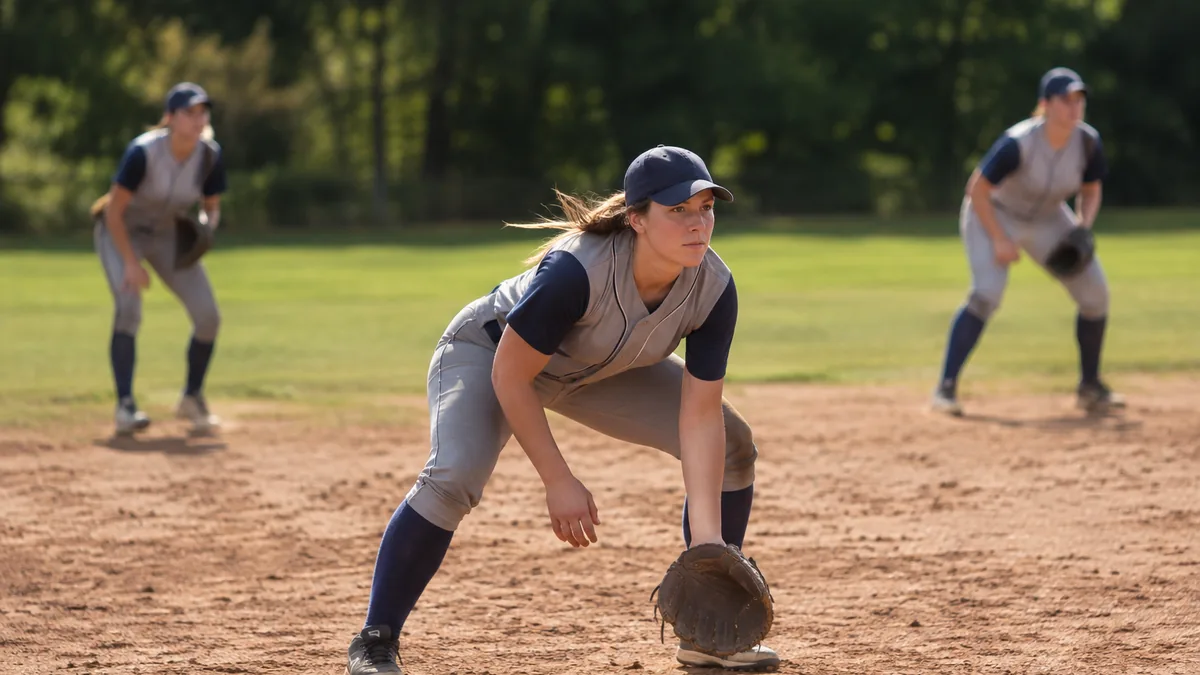
Softball uses the same basic defensive map as baseball, but the smaller field, the larger ball and the underhand pitch change how some positions are played. This guide lists every softball position, explains the extra fielder you will see in slowpitch, covers position numbers and the designated player, and ends with practical advice if you are choosing where to play.
Baseball Europe is an independent guide and is not an official federation site. For rules in your own league, always check that league's rulebook, because youth, recreational and international competitions differ.
The short answer: nine in fastpitch, ten in slowpitch
In fastpitch softball, the defense puts nine players on the field: a pitcher, a catcher, four infielders and three outfielders. This is the same arrangement as in baseball.
In slowpitch softball, which is common in adult recreational leagues, teams usually field ten players. The tenth player is an extra outfielder, often called a short fielder or rover, who stands in the outfield grass or the shallow outfield. Some leagues use different rules for how many players take the field, so check your local format.
The battery: pitcher and catcher
Pitcher (position 1)
In fastpitch, the pitcher throws underhand, usually with a fast arm circle often called a windmill, from a circle rather than a raised mound. The circle is much closer to home plate than a baseball mound. Pitchers use fastballs, changeups and movement pitches such as rise, drop and curve, and they need good control and strong legs.
In slowpitch, the pitcher lobs the ball in a high arc to help the batter put it in play. The job is less about speed and more about accuracy and fielding balls that come back quickly.
Because the pitcher stands close to the batter, softball pitchers also have to be ready to field a hard hit ball, which makes fast reactions and a good glove important.
Catcher (position 2)
The catcher squats behind home plate, receives pitches, calls pitches in many teams, blocks balls in the dirt, throws to bases and covers plays at the plate. In fastpitch, the catcher also helps defend against bunts and steals. The position requires protective gear: a helmet and mask, a chest protector and shin guards.
The infield
Four fielders play around the bases. The bases are closer together in softball than in baseball, so there is less time on every play.
First base (position 3)
The first baseman receives throws from the other infielders to get outs at first. A good first baseman has a reliable glove, stays on or near the bag, and can stretch to catch an off-target throw. In fastpitch, the first baseman also charges in on bunts, so quick feet matter.
Second base (position 4)
The second baseman covers the area between first and second base. This player turns double plays, covers second on steals and relays throws from the outfield. Quick hands and good footwork are the key skills.
Shortstop (position 6)
The shortstop plays between second and third base and often handles the most balls in the infield. It is usually a spot for an athlete with a strong arm, good range and quick decision-making. Shortstops also help cover steals and cut off throws.
Third base (position 5)
Third base is called the hot corner for a reason. The third baseman stands close to the batter, fields hard-hit balls, handles bunts and throws a long way across the diamond to first base. A strong arm and fearless reactions help most here.
The outfield
Outfielders cover the grass beyond the bases and keep hits from turning into extra bases.
Left field (position 7)
Left fielders cover the area down the left-field line and the gap toward center. They usually need a good arm to throw to third base or home.
Center field (position 8)
The center fielder runs the outfield. This player should have the best speed and range, calls for fly balls, and backs up the corner outfielders. Good communication is essential.
Right field (position 9)
Right fielders cover the right-field line and the gap toward center. They often make a long throw to third, and in some leagues the position is where players develop outfield skills.
Short fielder or rover (slowpitch only)
When a slowpitch team uses a tenth player, that player usually stands in short left-center or short right-center, or behind the infield, to catch hits that would otherwise fall between the infield and the outfield. A good short fielder reads the ball quickly and throws accurately.
Position numbers for scorekeeping
Scorekeepers use numbers to record plays, and the numbering is the same as in baseball:
| Number | Position |
|---|---|
| 1 | Pitcher |
| 2 | Catcher |
| 3 | First base |
| 4 | Second base |
| 5 | Third base |
| 6 | Shortstop |
| 7 | Left field |
| 8 | Center field |
| 9 | Right field |
A ground ball to shortstop thrown to first is scored 6-3, and a double play from third to second to first is 5-4-3. For a deeper look at numbering, see our baseball positions by number guide.
The designated player and flex
Fastpitch has a special arrangement. The designated player (often written DP) bats for one of the defensive players but does not play in the field. A partner called the FLEX plays defense, and the two spots can be tied together in the batting order under the rules of the league. The exact rules differ between governing bodies, so use the current rulebook for your league.
Slowpitch has its own variants, so check how many hitters and fielders you can use before the game.
How softball positions differ from baseball
- The pitcher throws underhand, from a circle, with a ball that is bigger than a baseball.
- The infield is smaller, so reaction time is shorter, especially for the corner infielders.
- The catcher faces a faster-moving ball at a short distance and often has more bunt plays to handle.
- Outfielders cover less ground in some situations but still need strong throws.
For a full comparison of the two sports, read our softball vs baseball guide. If you want the baseball version of this guide, see baseball positions explained.
Which position should you play?
Use your strengths as a guide.
- Strong arm and quick reactions: shortstop, third base or pitcher.
- Speed and good judgment: center field or second base.
- Soft hands and a steady glove: first base.
- Leadership and toughness: catcher.
- Reliable but still learning: right field or left field are good places to build skills, but remember that balls can reach outfielders at any time.
At youth level, coaches often rotate players through positions so everyone learns the game. Try several, since the position that looks most fun may not be the one that fits you best.
Common beginner mistakes
- Standing flat-footed. Fielders should be on the balls of their feet before the pitch.
- Not calling for the ball. Call "mine" on pop-ups and fly balls to avoid collisions.
- Forgetting the next play. Know where you will throw before the ball is hit.
- Neglecting backup duty. On many plays, an outfielder or infielder should be behind a teammate in case of a bad throw.
FAQ
How many positions are there in softball?
Fastpitch has nine fielding positions: pitcher, catcher, first base, second base, third base, shortstop, left field, center field and right field. Slowpitch often adds a tenth player, a short fielder or extra outfielder.
What is the hardest position in softball?
It depends on the player, but pitcher and catcher are often seen as the most demanding. Shortstop is also tough because it sees many balls. Each position needs different skills.
What is a DP in softball?
DP stands for designated player. The DP bats for a defensive player but does not play in the field. A partner called the FLEX plays defense. Exact rules vary by league.
Do softball positions use the same numbers as baseball?
Yes. Pitcher is 1, catcher is 2, first base is 3, second base is 4, third base is 5, shortstop is 6, left field is 7, center field is 8 and right field is 9.
What is the best softball position for a beginner?
Right field or first base are often good starting spots, but many coaches rotate beginners through several positions so they can find what suits them.