
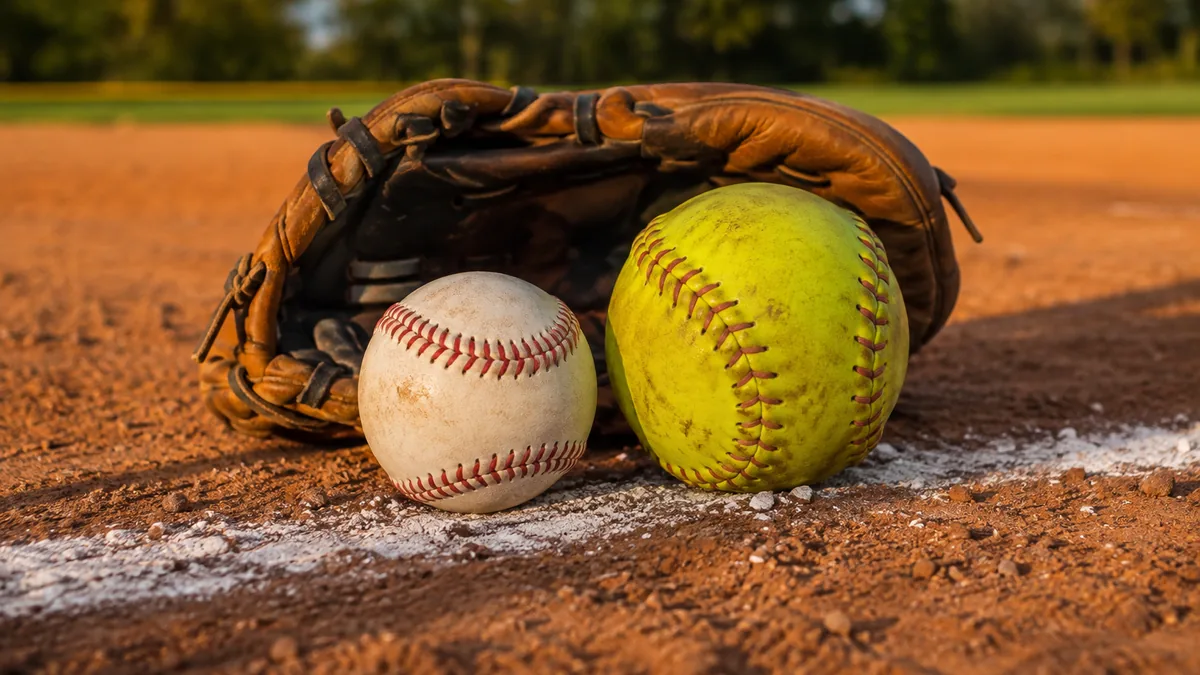
Softball and baseball look alike from the stands: a diamond, a bat, a ball, gloves, nine players in the field. Spend ten minutes watching, though, and the differences jump out. The ball is bigger, the pitcher throws underhand, the bases are closer together, and the game is shorter. This guide goes through each difference in turn, so you can pick the right equipment, understand what you are watching, or explain it to a friend who is switching from one sport to the other.
A quick note before we start: both sports have several versions. Baseball is played with different rules at youth, high-school, college and professional level. Softball has two main styles, fastpitch and slow pitch, and they differ from each other quite a bit. The numbers below describe the usual setups, and your league's rulebook always wins.
The short answer
Softball is a bat-and-ball game derived from baseball and played on a smaller field with a larger ball and, in the most common competitive form, underhand pitching. The basic idea is the same: score runs by hitting, running the bases and touching home plate, while the defense tries to record three outs in each half inning. Everything else (equipment, distances, pace) is tuned to a different scale.
Quick comparison table
| Feature | Baseball | Softball |
|---|---|---|
| Ball | Smaller, about 9 inches around | Larger, commonly 12 inches around (some leagues use 11) |
| Pitching | Overhand from a raised mound | Underhand (windmill in fastpitch, arc in slow pitch) from flat ground |
| Distance between bases | 90 feet | Commonly 60 feet |
| Pitching distance | 60 feet 6 inches at the top level | Much shorter; varies by age and league |
| Innings | Nine in a standard game | Seven in a standard game |
| Base running | Runners may lead off before the pitch | In fastpitch, runners must stay on base until the ball leaves the pitcher's hand |
| Outfield fence | Typically far | Typically closer; varies by field |
Treat the exact distances as typical values. Youth leagues, adult leagues and different governing bodies set their own measurements.
The ball
The most obvious difference is the ball. A baseball is small and hard with red stitching. A softball is noticeably larger, and despite the name, it is not especially soft in competitive play. Most fastpitch and many slow-pitch leagues use a ball around 12 inches in circumference, and some leagues use an 11-inch ball. Softballs are often bright yellow, which helps players see them, although white balls are also used.
The larger ball changes how the game feels. It is harder to hit very far, easier to field in the sense that it is a bigger target, and it travels differently once it leaves the bat.
Pitching
This is the difference that most changes the game.
In baseball, the pitcher throws overhand from a raised mound, and top-level pitchers can reach very high velocities. Breaking balls like curveballs and sliders, plus changeups and fastballs, are the toolkit. To see where the pitcher fits among the other eight fielders, read our baseball positions explained guide.
In fastpitch softball, the pitcher throws underhand with a windmill motion from a circle on flat ground, much closer to the batter than in baseball. The ball speeds are lower in miles per hour, but the shorter distance leaves the batter less time to react, so the game feels fast. Fastpitch pitchers throw rise balls, drop balls, curves and changeups that move differently from their baseball equivalents.
In slow-pitch softball, the pitcher lobs the ball in a high arc to the plate. The game is built around putting the ball in play, so there are lots of hits, fielding chances and runs.
The field
A baseball diamond has 90-foot base paths, a raised pitcher's mound and a deep outfield. Softball diamonds are smaller. A common softball base path is 60 feet, and the pitcher throws from flat ground rather than a mound. Outfield fence distances vary by field and level. Because the infield is tighter, plays happen faster, and fielders have to react more quickly.
Both sports use the same basic positions: pitcher, catcher, first base, second base, shortstop, third base and three outfielders. Slow-pitch often adds a fourth outfielder, or a short fielder, to make ten players. If you need a refresher, our guide to baseball positions by number explains the scoring numbers.
Innings and game length
A standard baseball game is nine innings, with extra innings if the score is tied. A standard softball game is seven innings. Lower levels of both sports often use shorter games or time limits. Many amateur leagues in both sports also have run-limit rules that end a game early when one team leads by a large margin, often called a mercy rule, but the specifics differ from league to league.
Base running and stealing
Baseball runners can take a lead off the base while the pitcher is getting ready, and they can try to steal as soon as the pitcher begins his motion. In fastpitch softball, a runner must keep contact with the base until the pitcher releases the ball, and only then may she leave. That changes the timing of steals and makes the running game more about reaction and speed off the base than about reading the pitcher's motion.
Slow-pitch softball usually does not allow stealing at all, or restricts it heavily, because the ball spends so much time in the air.
Bats and gloves
Softball bats and baseball bats are made differently because the balls differ. Bats must meet the standards of the league you play in, so check the stamp or rules before buying. The same applies to gloves. Gloves are sold for the sport as well, because the ball is a different size. When in doubt, ask your league or a specialist shop. Our baseball glove size chart is a good starting point for understanding sizes, and our bat size chart helps with bat sizing for baseball.
Which sport should you choose?
Choose baseball if you enjoy the pitcher-versus-batter duel at long range, the strategy of a long game and the tradition. Choose fastpitch softball if you like quick reactions, a compact field and fast action. Choose slow-pitch softball if you want a sociable game that people of very different abilities can enjoy together.
Many players do both. Skills carry over: throwing, catching, tracking a fly ball and baserunning instincts all transfer, although you need time to adapt to the different timing.
FAQ
What is the main difference between softball and baseball?
The pitching style and the ball size. Softball uses a larger ball and, in fastpitch, underhand pitching from a shorter distance, while baseball uses a smaller ball pitched overhand from a raised mound.
Is a softball bigger than a baseball?
Yes. A baseball is about 9 inches around, while most softballs are 11 or 12 inches around, depending on the league.
How many innings are in softball and baseball?
A standard baseball game has nine innings and a standard softball game has seven, although youth and recreational leagues often use shorter limits.
Is softball easier than baseball?
Not necessarily. The ball is larger, but the field is smaller, so the pitcher is closer and plays happen faster. Each sport asks for different skills, and difficulty depends on the level.
Can you use a baseball glove for softball?
You can in a pinch, but a softball glove is often designed for the larger ball. For regular play, use a glove made for your sport and check league rules.