
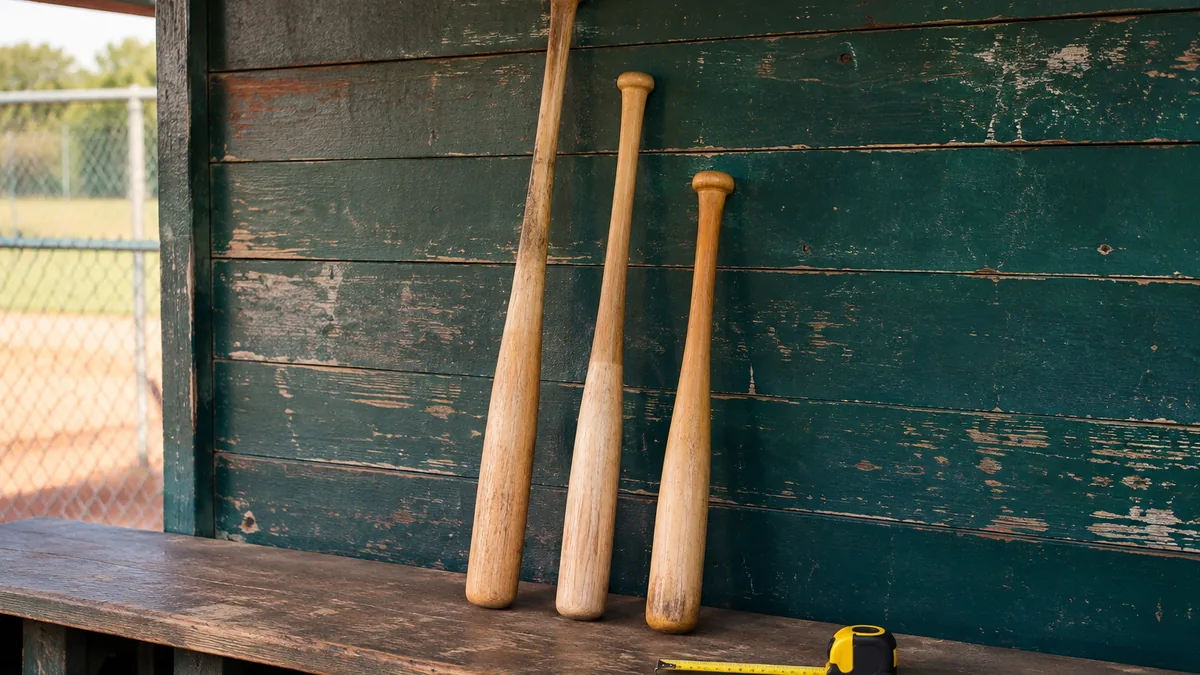
A bat that is the wrong size can ruin a swing. Too long and heavy and the barrel drags through the zone. Too short and light and you give up reach and power. Unlike gloves, bats have a single measurable fit problem to solve, but the shopping process is complicated by three overlapping systems: length in inches, weight in ounces, and the league certification stamped on the barrel.
This guide explains each of those, shows you simple ways to test fit, and gives you a checklist to follow before you buy. It deliberately avoids a giant age-by-age table, because published charts disagree and a bat should be matched to a player, not to an age.
Three numbers to understand: length, weight and drop
Length is measured in inches from the knob to the end cap. Bats are sold in one-inch steps, and longer bats give more reach but are harder to swing fast.
Weight is measured in ounces. A heavier bat can carry more momentum if you can swing it at speed. If you cannot, a heavier bat only slows you down.
Drop (also written "drop weight" or "length-to-weight ratio") is the length in inches minus the weight in ounces. A 30-inch bat weighing 20 ounces is a "drop 10," written -10. A lower number means a heavier bat for its length. A -3 bat is much heavier than a -10 bat of the same length.
Why does drop matter? Because it tells you quickly how heavy a bat feels. Younger and smaller players generally do better with a bigger drop (lighter bat). Older and stronger players usually move to smaller drops, and high school and college players use the lowest drop their rules allow. For the definition of drop weight, see the general description in Wikipedia: Baseball bat.
Know your league standard before anything else
Bats carry a stamp for the standard they meet, and each league decides which stamps it accepts. Buying the wrong one is the most expensive sizing mistake.
| Standard | Who generally uses it | Notes |
|---|---|---|
| USABat | Youth leagues that adopted the USA Baseball bat standard, including Little League and many others | Introduced in 2018; check the stamp on the barrel |
| BBCOR | High school and college | Requires a -3 drop and a 2 5/8 inch maximum barrel |
| USSSA | Some travel and tournament organizations | Rules differ by event |
| Wood or composite wood | Professional, some collegiate summer leagues, some adult leagues | Different rules for each league |
These descriptions are summaries. The details change, and each organization publishes its own rules. Check the current list at your league's site; for example, Little League playing rules and USA Baseball have equipment information. If your league has a list of approved bats, buy from it.
A bat that does not meet the standard may be removed from a game, so never assume that a bat is legal because a store sells it.
How to choose length
The most reliable ways to pick length are simple and cheap.
The arm test
Hold the bat by the knob and place the end of the barrel in the center of your chest. Extend your arm straight out to the side along the bat. If your fingertips just touch the barrel end, the length is a reasonable starting point. If you cannot reach, the bat is long. If you reach beyond the end, it may be short.
The side test
Stand the bat on its end next to your leg. The knob should reach roughly to the top of your hip or the point where your palm rests with your arm at your side. This gives a rough range, not an exact answer.
The height guide
Some retail guides give simple height ranges for adults. One calculator we reviewed suggested that players about 5 feet 8 inches to 5 feet 11 inches typically use 32 to 33 inch bats, while players 6 feet and taller use 33 to 34 inches. Treat such lines as starting points, because they do not know your build, your swing or your league.
Use a manufacturer chart for youth sizes. Brands publish their own charts based on height and weight, and they are more reliable than a generic age table.
How to choose weight and drop
Length and weight work together. A useful approach:
- Start with a bat of the right length.
- Pick a drop your league allows. For BBCOR, this is fixed at -3. For youth bats, there is usually a range, often described by retailers as -5 to -12, but confirm in your league's rules.
- Test the swing. Take 10 full swings. If the barrel drags, drops or wobbles toward the end of the swing, the bat is probably too heavy.
- Check bat speed by feel. A bat should feel like you control it, not like it controls you.
A common mistake is buying a bat that is too heavy because "I will grow into it." A bat that is too heavy encourages bad mechanics, such as dipping the back shoulder or casting the hands. Choose the bat you can swing correctly now.
If you are caught between two lengths, many coaches advise the shorter and lighter bat. That is a judgment call rather than a rule, but it reflects a simple principle: control first, then add size.
Two-piece, one-piece, composite and alloy
Materials also affect feel and price.
- Alloy (aluminum) bats are durable, ready to use out of the box and often more affordable.
- Composite bats can have a larger sweet spot and less vibration, usually cost more and may need a short break-in with real balls, depending on the manufacturer's guidance.
- Hybrid bats combine an alloy barrel with a composite handle.
- One-piece bats feel stiffer and are often preferred by players who want direct feedback.
- Two-piece bats flex more in the handle and reduce vibration, which can be more comfortable on mishits.
- Wood bats are the choice for professional play and are sometimes recommended for training because they punish poor contact.
None of these types is "best" for everyone. Choose by league rules, comfort and budget.
Barrel diameter
Youth bats come in barrel diameters including the traditional 2 1/4 inch and the larger 2 5/8 inch barrels used by many modern standards. A larger barrel means a bigger hitting surface and typically more weight at the same length. Your league's rules decide which one you can use. BBCOR bats are limited to 2 5/8 inches.
Handle grip and knob
Small details change comfort:
- Grip thickness. A thicker grip cushions the hands but may feel clumsy to a small hand.
- Flared knobs. They stop the bat from slipping out of the hands.
- Replacement grips. A worn grip can be replaced cheaply, extending the life of the bat.
Common bat-buying mistakes
- Buying by age instead of by height, strength and league rules.
- Buying a heavier bat to "grow into."
- Assuming a bat is legal because it is sold in a store.
- Choosing by brand name or by what a professional uses.
- Ignoring the rules for BBCOR or USABat stamps.
- Leaving a bat in a hot car, which can damage composites.
A short pre-purchase checklist
- Find out which bat standards your league requires.
- Measure height and weight, and use the manufacturer's chart.
- Do the arm test with the bat in hand if possible.
- Choose a drop that allows a clean swing.
- Take practice swings in the store or at home.
- Check the return policy before buying online.
- Keep the receipt and register any warranty.
Sizing for different players
Young beginners. Prioritize light weight and a short length. A lighter bat helps build good mechanics and keeps swings fun.
Growing youth players. Re-check fit every season. Hitting performance and comfort can change quickly as a child grows.
High school and college players. BBCOR rules fix the drop at -3; focus on length, balance and swing weight.
Adults in recreational leagues. Check your league's bat rules. Some allow composite and alloy bats, and some require wood.
For related gear choices, read our guides to choosing baseball cleats and glove sizing.
Sources
- Baseball bat, Wikipedia, for definitions of bat parts and standards.
- Little League playing rules, for youth equipment regulations.
- USA Baseball, for information on the USABat standard.
Always check the current official rules, because standards change.
FAQ
How do I choose a baseball bat?
Start with your league's required standard, then pick a length using the arm test or a manufacturer chart, then choose the lightest drop you can swing with good form.
What does the drop mean on a baseball bat?
Drop is the length in inches minus the weight in ounces. A 30-inch, 20-ounce bat is a -10. A smaller drop number means a heavier bat for its length.
What size baseball bat for an 8 year old?
It depends on height, strength and league rules. Use the manufacturer's height and weight chart and the arm test, and favor a lighter bat that the child can swing smoothly.
How do you measure for a baseball bat?
Hold the bat with the barrel end at the center of your chest and extend your arm along it. If your fingertips just reach the end, the length is a good starting point.
Is a heavier bat better?
Only if you can swing it fast and with good mechanics. For most players, control and bat speed matter more than weight.