
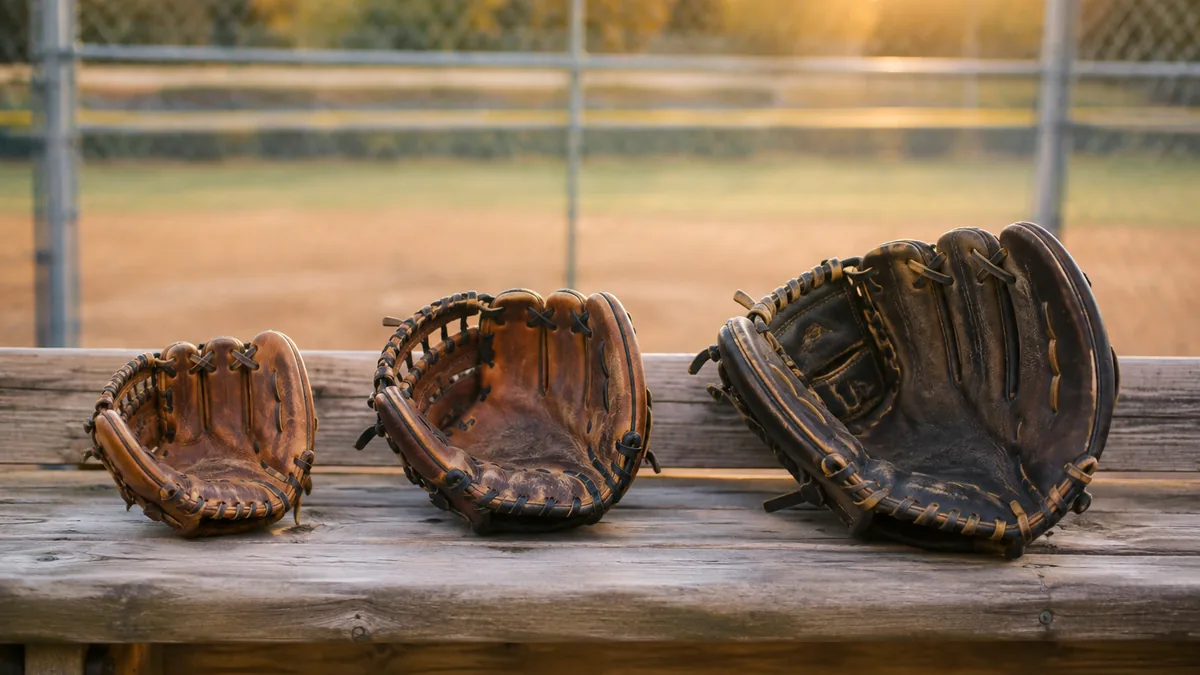
Glove size is printed on the glove as a number of inches, and that number is not a measure of your hand. It is the distance from the top of the index finger, down the front of the glove, to the heel of the palm. Because the number describes the glove, not you, the right size depends on three things: your position, your age or hand size, and the level at which you play.
The chart below pulls together ranges that retailers and manufacturers publish. Different brands round differently, and the published sources do not agree on every number, so treat any chart (including this one) as a starting range and then check the size guide for the exact model you plan to buy.
The quick answer: glove size by position
| Position | Typical adult range | Why |
|---|---|---|
| Infield (2B, SS, 3B) | about 11 to 12 inches | Smaller glove, shallow pocket, ball comes out fast |
| Pitcher | about 11.5 to 12 inches | Mid-size, often a closed web to hide the grip |
| Outfield | about 12 to 12.75 inches | Longer reach for fly balls, deeper pocket |
| First base | about 12 to 13 inches | A mitt shape with a long, scooping pocket |
| Catcher | about 32 to 34 inches (circumference) | A padded mitt measured around the edge, not by length |
These ranges follow the pattern in published retailer charts. One museum guide gives T-ball sizes starting at roughly 9 to 10 inches and adult outfield gloves up to 12.75 inches, and notes that catcher's mitts are measured by circumference rather than length. Retailer charts for adult infield gloves vary slightly, with one guide listing 11.25 to 12 inches. That spread is normal.
Why does position matter? Infielders need to get the ball out of the glove quickly, so a smaller glove with a shallow pocket works better. Outfielders trade speed of transfer for reach. First basemen catch hard throws from every direction and benefit from a long mitt that scoops low throws out of the dirt.
Glove size by age
Age is a rough proxy for hand size. The table below uses ranges published in retailer size charts from Rawlings and Mizuno listings. Younger players should lean toward the smaller end.
| Age group | Common range | Notes |
|---|---|---|
| T-ball (about 3 to 6) | 8.5 to 10 inches | Published charts use this range for every position |
| Youth (about 7 to 12) infield | 9 to 11 inches | Some charts stretch the top end slightly |
| Youth outfield | 9.5 to 11.5 inches | Slightly longer than infield |
| Youth first base | 11.5 to 12 inches | Mizuno retail chart lists this for ages 7 to 12 |
| Teen (13 and up) | 11 to 12.5 inches | Moves toward adult sizes by position |
What size baseball glove for an 8 year old?
This is one of the most searched questions in the entire gear category. For an average 8-year-old, published youth charts point toward roughly 10 to 11 inches for infield or general use, and up to about 11.5 inches for outfield. A very small child can start at the smaller end; a tall child with a larger hand can use the upper end.
The same logic applies at neighboring ages. A 6-year-old usually fits in the 9 to 10 inch range, a 7-year-old a little higher, a 10-year-old toward 11 to 11.5 inches. Be wary of buying "one size up to grow into." A glove that is too large is harder to close, slows the transfer and teaches bad catching habits.
How to measure a baseball glove
You can measure a glove you already own, or check a listing before buying, with a flexible tape measure.
- Lay the glove flat with the palm side up, or hold it on your hand if it is already in use.
- Place the end of the tape at the very top of the index finger.
- Run the tape down the front of the glove, along the finger and the palm, to the heel, which is the bottom edge of the glove where the palm ends.
- Read the length in inches. That is the size printed on the glove.
Catcher's mitts follow a different rule. They are measured around the circumference of the mitt, which is why their numbers run from the low 30s upward.
If you are measuring a person rather than a glove, measure the hand from the base of the palm to the tip of the middle finger and then compare it with the brand's size guide. A larger hand does not automatically need a larger glove, though. Position and age usually matter more.
Left-hand throw versus right-hand throw
Gloves are labeled by the hand that throws, which is confusing for beginners. A glove marked RHT (right-hand throw) goes on the left hand, and a glove marked LHT (left-hand throw) goes on the right hand. If you throw with your right hand, you want a glove that fits your left hand, the RHT model. Check this carefully when ordering a youth glove online, because a wrong-hand glove is a common return.
Sizing details that charts don't show
- Hand opening. Brands cut the finger stalls and wrist differently. A glove can have the correct length and still feel loose or tight. Youth gloves often advertise a "snug fit" for small hands.
- Padding. A thick palm pad makes a glove feel smaller on the hand. Thin padding makes it feel larger.
- Web style. Open webs, such as an I-web, let you see the ball through the glove and are common in the infield. Closed webs give more support for pitchers. The web does not change the length, but it changes the feel.
- Material. Soft, light leather or synthetic gloves often work better for the smallest players, who may not have the strength to close a stiff glove.
- Brand. Two 11.5 inch gloves from different makers can feel different. Always read the model-specific chart.
Softball and baseball are not the same
Softball gloves often run larger because the ball is bigger. Retailer charts for Rawlings softball list slightly larger youth ranges than baseball. Do not assume a softball size matches a baseball size when browsing; the sports use different patterns, and some retail sites combine them in one chart. If you are playing both, buy the glove for the sport you play most. A softball glove can technically catch a baseball, but it will not behave like a baseball pattern, and the opposite is also true.
Fit test in the store or at home
Before you commit to a glove, check these points:
- Put it on. Your fingers should reach the ends of the finger stalls without being jammed in.
- Open and close it. A new glove will be stiff, but you should be able to close it slowly with the hand you plan to catch with.
- Check the heel. The ball should land in the pocket, not on the heel or the very tips of the fingers.
- Check the wrist strap. It should hold the glove on without cutting off your circulation. Most gloves have a laced or Velcro adjustment.
Once you have a glove that fits, read how to break in a baseball glove and how to keep it in good shape.
Buying notes
Gloves that look similar can differ greatly in price and quality, and sizing is only the first filter. Decide on position, then size range, then budget, then leather. For children who will change positions and grow quickly, a mid-range or entry-level glove is a sensible choice. Serious adult players tend to buy position-specific models. If you play multiple positions, a roughly 11.5 to 12 inch glove is a common compromise in adult play.
Sources
- Rawlings gloves size chart, Hibbett
- Rawlings gloves size chart, Scheels
- Mizuno baseball and softball gloves size chart, Scheels
- Baseball glove, Wikipedia
FAQ
What size baseball glove for an 8 year old?
Most published youth charts suggest about 10 to 11 inches for infield or general use and up to about 11.5 inches for outfield. Choose by position and hand size, and avoid buying much bigger to "grow into."
How do you measure a baseball glove size?
Run a tape measure from the top of the index finger, down the front of the glove, to the heel of the palm. The result in inches is the glove size. Catcher's mitts are measured by circumference instead.
What size baseball glove should an adult use?
It depends on the position. Adult infielders often use about 11 to 12 inches, pitchers around 11.5 to 12, outfielders about 12 to 12.75, and first basemen mitts of around 12 to 13 inches. Catchers use mitts measured at about 32 to 34 inches around.
Does a bigger glove help you catch better?
Not necessarily. A glove that is too big is harder to close and slows the transfer to your throwing hand. Match the size to your position and your hand.