
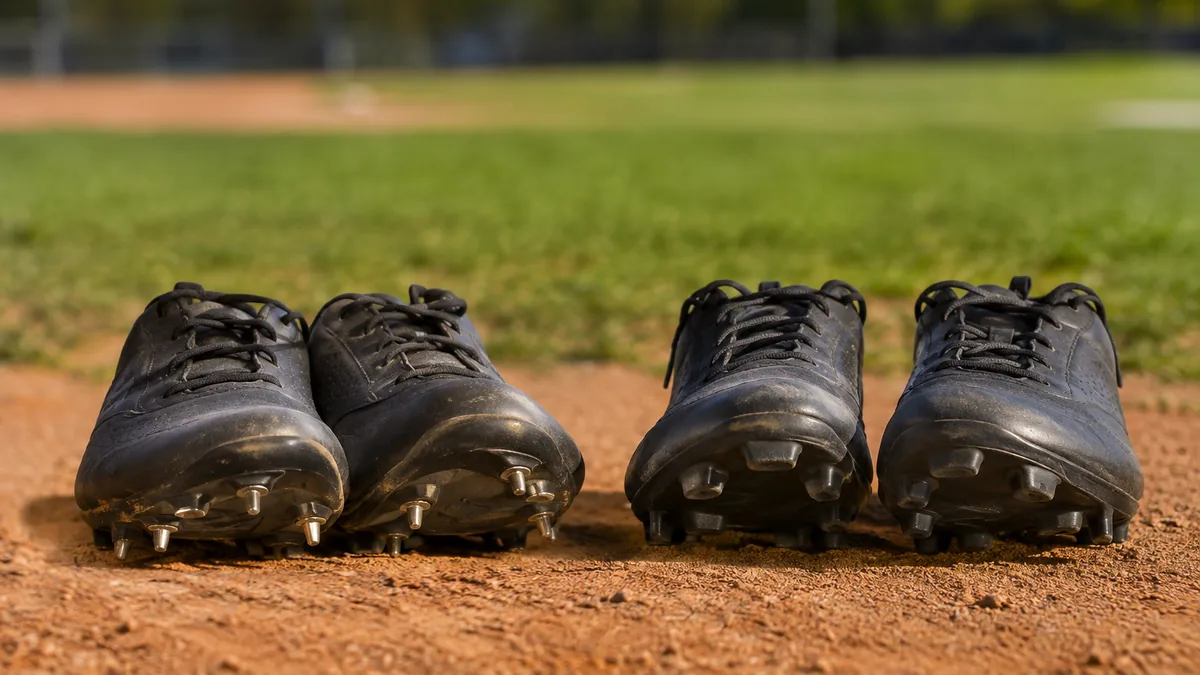
Walk into any baseball shop and you will find two main families of cleats: metal and molded. They look similar from the side, but the soles behave differently on dirt, grass and turf. Players often ask which is better, and the honest answer is that it depends on your age, your league's rules, the field you play on and how much you want to spend.
This guide compares the two types, explains where each one shines and gives you a simple way to choose. For a broader buying overview, including fit and sizing, see our baseball cleats buying guide.
The short answer
- Molded cleats have rubber or plastic studs built into the sole. They are comfortable, widely allowed and good for most youth and recreational players.
- Metal cleats have thin metal spikes, usually screwed or fixed into the sole. They dig deeper into the ground, which helps with traction on natural dirt and grass, and they are common at higher levels of play.
If your league bans metal, the decision is already made. If it allows both, think about the surface you play on and how much grip you need.
How molded cleats work
Molded cleats use studs that are part of the outsole. The studs are wider and shorter than metal spikes, so they spread pressure over more of the foot. The result is a shoe that is comfortable to wear for a full game and kinder to bare floors and car parks.
Advantages of molded cleats
- Comfort. The pressure is spread out, which many players find easier on the feet.
- League friendliness. They are accepted in nearly all youth leagues.
- Versatility. They work on dirt, grass and many artificial surfaces.
- Lower maintenance. There are no replaceable parts to lose.
- Price. Molded pairs are often less expensive than comparable metal pairs, though prices vary by brand and model.
Disadvantages of molded cleats
- Less bite in soft or wet natural ground, so you may slip more on a hard start or push-off.
- The studs can wear down faster on abrasive surfaces.
How metal cleats work
Metal cleats have narrow spikes, often arranged in a pattern at the toe and heel. Because the spikes are thin, they dig into the surface and hold. That extra grip helps with fast starts, hard turns and stolen bases.
Advantages of metal cleats
- Grip. Metal gives stronger traction in dirt and natural grass.
- Speed off the mark. Sprinters and base stealers appreciate the push.
- Performance level. Many older and competitive players choose metal.
Disadvantages of metal cleats
- League bans. Many youth leagues restrict or ban metal spikes. Always check your league's rules before buying.
- Safety concerns. Metal spikes can cause more serious cuts if a player is stepped on. This is a major reason for youth bans.
- Hard surfaces. Metal cleats are uncomfortable and slippery on concrete, and walking to the field can be awkward.
- Not for turf. Metal spikes can damage some artificial surfaces. Check the field rules.
League rules: check before you buy
Rules differ by organization, age group and country. Some youth leagues allow only molded cleats up to a certain age, while others allow metal at older divisions. Some adult leagues and fields have their own restrictions on metal spikes, especially on turf. Because the rules change, we cannot give a single answer that applies everywhere. Look for the equipment section in your league's rulebook, or ask your coach or league administrator. If you play in Europe, remember that rules can differ from one national federation or club to the next.
Which surface is it?
Natural dirt and grass
Metal gives the best grip, and molded works well when the ground is firm. If the field is soft or wet, metal digs in more.
Artificial turf
Many players prefer molded cleats or dedicated turf shoes with a rubber nubbed sole. Some turf fields prohibit metal, so ask first. For more on turf shoes, see our article on using football or soccer cleats for baseball.
Hard or dry dirt
Molded studs can be enough, and they are more comfortable on baked ground.
Which player are you?
- Young players (little leagues). Choose molded unless your league clearly allows metal. Comfort and safety come first.
- Teen players moving up. Check rules at each new level. Many players switch to metal in high-school or club baseball when the rules allow it.
- Adult recreational players. Molded is often enough, and it is more comfortable for casual games.
- Competitive players and base stealers. Metal can help with traction, if the league allows it.
- Players on mixed surfaces. Consider two pairs: one molded or turf pair, and one metal pair for natural fields.
Tips for buying and looking after cleats
- Fit first. Cleats should be snug but not painful. Leave about a thumb's width of space at the toe and check heel slip.
- Try with game socks. The thickness changes the fit.
- Break them in. Wear new cleats at home or in practice before a match.
- Clean after use. Knock off dirt, wipe the upper and let them dry at room temperature.
- Check the sole. Worn studs and loose spikes reduce grip and can be a safety issue. Replace the pair when the studs are worn or damaged.
- Do not wear metal on hard surfaces. Carry them to the field and put them on near the dugout.
A simple decision guide
Ask yourself three questions. First, does my league allow metal? If not, buy molded. Second, what surface do I play on most? Turf points toward molded or turf shoes; natural dirt leaves both options open. Third, do I need maximum grip, or maximum comfort? If you are unsure, start with molded. You can move to metal later when your league allows it and your game needs it.
FAQ
Are metal baseball cleats better than molded?
Metal cleats give more traction on natural dirt and grass, but they are not better for everyone. Comfort, safety and league rules matter, and molded cleats are often the better choice for youth and recreational players.
Can you wear metal cleats in Little League?
It depends on the division and local rules. Many youth leagues restrict metal spikes, so check the rulebook of your own league before you buy.
Can you wear molded cleats on turf?
Yes, in many cases. Molded cleats or turf shoes with a nubbed sole are commonly used on artificial turf. Check the field's own rules.
Do metal cleats hurt your feet?
They can feel less comfortable than molded cleats because the pressure is concentrated at the spikes, especially on hard ground. Good fit and socks help.
How long do baseball cleats last?
It depends on how often you play, the surface and how you take care of them. Replace them when the soles or studs are worn, the upper is damaged or the fit has become poor.