
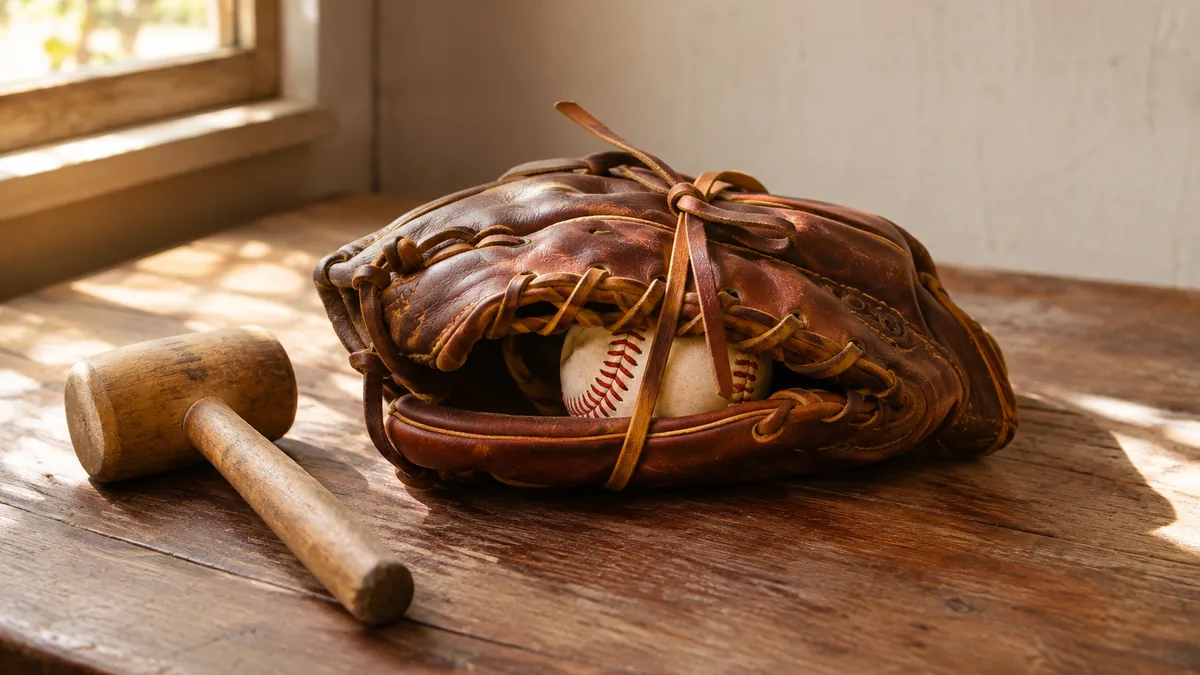
A new baseball glove is stiff on purpose. Full-grain leather has to hold its shape through thousands of catches, so it arrives firm, flat and a little awkward. Breaking it in means teaching that leather where to bend. Do it well and the glove closes around the ball with almost no effort. Do it badly, with too much heat, too much oil or too much force, and you can end up with a floppy, cracked or misshapen glove that costs more to replace than it did to buy.
This guide covers the approach that works for most players, from a nine-year-old with a first glove to an adult league infielder. It also explains the shortcuts people recommend online and which of them are worth the risk.
What "broken in" actually means
A broken-in glove has three qualities. The hinge, which is the line across the palm where the glove folds, closes smoothly. The fingers curl toward the thumb without you forcing them. And the pocket, the spot where the ball lands, is deep enough to trap the ball and sits in the right place for your position.
Break-in does not mean the glove should feel like a sock. Game-ready gloves keep some structure in the fingers and the web. If the glove is limp, the ball will knock it open and out of your hand, and a soft glove also offers less protection.
Stiffness varies a lot. Entry-level youth gloves are often made from softer, thinner leather and may need only a few days of catch. Heavier full-grain gloves, especially adult infield and first-base models, can take weeks of regular use. Plan for that when you buy. If the season opener is in ten days, do not order a stiff pro-style model and hope.
The reliable method: play catch
Almost every glove maker and coach will tell you the same thing: the best break-in is use. Throwing and catching with the glove shapes it to your hand and to the way you catch.
- Start with soft tosses. Ten to fifteen minutes of easy throwing at short distance is enough on day one. Let the ball hit the pocket every time rather than the fingertips or the heel.
- Catch in the same place. If you want a pocket that sits where you naturally catch, make the ball land there repeatedly.
- Open and close it by hand. While watching TV, squeeze the glove closed and open it again. Fold it along the hinge a few dozen times.
- Increase distance and speed gradually. Over two weeks, work toward the throwing distances you will see in games.
Playing catch is slow, but it is the only method that also teaches you how the glove behaves. It is also the lowest-risk one, which matters if you are a parent breaking in a glove for a child who will outgrow it in a season or two.
Faster shaping: the ball-and-wrap method
If you want to speed things up without leaving the safe zone, build the pocket deliberately.
- Put a baseball (or a softball for a larger pocket) in the spot where you want the pocket to form.
- Fold the glove closed around the ball, the way it would close on a catch.
- Wrap it with a thick rubber band, a belt, or a glove wrap so the pressure stays on the fold.
- Leave it overnight, or for a day, and repeat several times over a week or two.
This is the version of "how to break in a baseball glove overnight" that actually holds up. One night will not finish the job, but it starts the pocket in the right place. Keep the ball in the center of the pocket rather than pushed toward the fingers, because a pocket that is too deep and too far forward is hard to close on a throw.
Some players also use a glove mallet, a wooden or rubber-headed hammer, to pound the pocket. Short sessions of firm taps on the pocket and the inside of the web can soften leather. Do not strike the stitching or the thin edges, and stop when the leather starts to flex easily.
Conditioning: a light touch only
New gloves usually come with leather that is already treated. Most of the time, they need very little extra product. If the leather feels dry, use a small amount of a conditioner made for baseball gloves, applied with a cloth, on the palm, hinge and finger flex points. A thin coat is enough.
Too much oil is one of the most common mistakes in the entire hobby. Soaked leather becomes heavy and loses its snap. It can also stretch laces and lining, and a glove that is oversaturated can take a very long time to recover. For more on this, see our guide to glove care, oil, cleaning and relacing.
Shortcuts to be careful with
Search results are full of dramatic tricks. Here is a plain read on the most common ones.
- Microwave or oven. Heat dries leather and can shrink or crack it. Many glove makers specifically warn against it. If you want warmth, a short exposure to a hair dryer on low is a gentler version, but even that carries some risk. We suggest skipping heat entirely.
- Soaking in water. Water makes leather temporarily pliable, but it can also dry unevenly, stiffen and distort the shape. Not recommended.
- Running it over with a car. A viral stunt. It tends to flatten the glove and ruin the pocket.
- Sleeping on it. Harmless but ineffective on its own. Use the ball-and-wrap method instead.
- Professional steaming. Some sporting-goods stores and glove specialists offer shaping services. If you are buying a premium glove, this can be a sensible option because the staff handle the heat.
The pattern is simple: the faster and more extreme the method, the greater the chance of damaging the leather. A glove that takes two extra weeks to soften is a cheaper outcome than one that has to be replaced.
A realistic timeline
| Glove type | Typical effort | What to expect |
|---|---|---|
| Entry-level youth glove | Several days of catch | Often usable almost right away |
| Mid-range synthetic or mixed leather | One to two weeks | Soft quickly, may stay a bit thin |
| Full-grain adult glove | Two to four weeks or more | Stiff at first, holds shape well when done |
| Catcher's mitt or first-base mitt | Several weeks | Padding and wide pocket take longer to flex |
These are rough planning numbers, not manufacturer guarantees. Your own result will depend on the leather, the pattern, how often you use it and your climate.
Break-in by position
Infielders usually want a shallower pocket so the ball comes out fast for the throw. Do not build a deep pocket with the ball-and-wrap method; use a smaller ball, or fold the glove less aggressively.
Outfielders can use a deeper pocket because they have more time to transfer the ball. The ball-and-wrap method with a full baseball works well.
Pitchers often prefer a closed web that hides the grip, so concentrate on the hinge and the fingers rather than a deep pocket.
Catchers and first basemen use specialized mitts with heavy padding and stiff leather. These need longer, so spend time on the hinge and the break point of the thumb and pinky side. Their sizing works differently from standard gloves; see our glove size chart first.
Common mistakes
- Choosing a glove that is too big, hoping to "grow into it." A glove that is too large never feels right, however well it is broken in.
- Breaking in only the pocket and ignoring the fingers.
- Storing the glove flat or jammed in a bag with the pocket stretched open. Keep a ball in the pocket and a band around it between uses.
- Using the glove wet and then leaving it in a hot car.
- Applying oil every week "just in case."
Sources and further reading
For the basic design of the baseball glove and its parts, see the Wikipedia article on the baseball glove. Retailer size guides such as the Rawlings glove size chart at Scheels show how manufacturers pair glove length with position. Always follow the care card or website for your specific brand, because leather types and treatments differ.
FAQ
How long does it take to break in a baseball glove?
It depends on the glove. A youth glove may feel ready in a few days of catch, while a stiff full-grain adult glove can take several weeks. If the ball pops out of the pocket or the glove will not close on its own, it is not ready yet.
How do you break in a baseball glove overnight?
You can start the pocket overnight by placing a ball in it, wrapping the glove tightly with a band and leaving it for the night. It will not finish the job in one night. Follow it with a few days of playing catch.
How do you soften a baseball glove quickly?
Squeeze and fold the glove by hand, work the pocket with a glove mallet, and play catch. Use only a thin coat of a glove-specific conditioner. Avoid ovens, microwaves and soaking, which can damage the leather.
Can I use a glove for games before it is fully broken in?
Yes, if it closes reasonably well and the ball stays in the pocket. For younger players, a glove that is too stiff can cause missed catches and discourage them, so more catch practice first is worth it.